

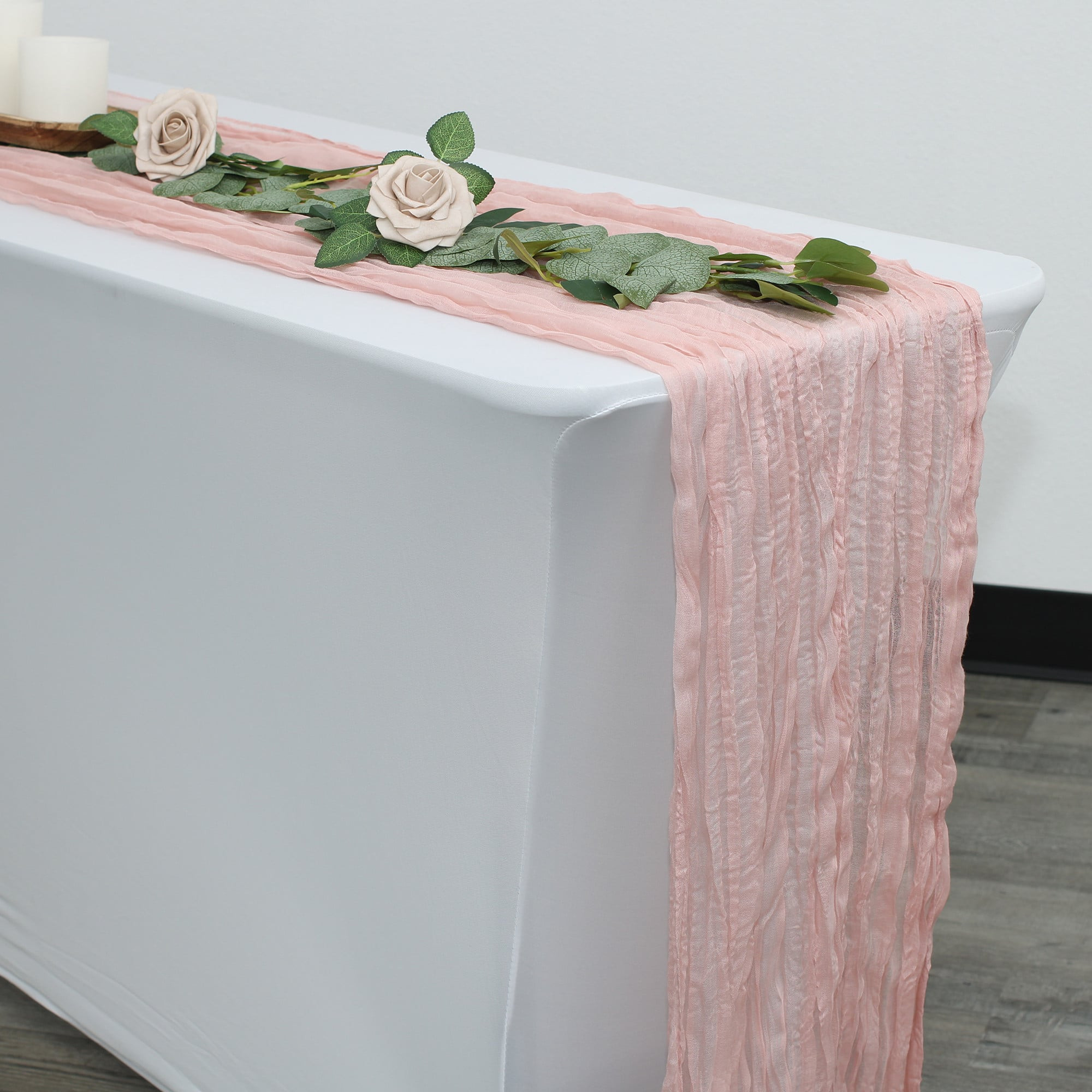
A table runner can look beautifully relaxed and still be the wrong length for your table. Before choosing a color, decide how far you want the ends to hang. A 6-foot table and an 8-foot table use the same calculation, but they leave very different amounts of fabric for draping.
The quick answer
A 108-inch runner leaves an 18-inch drop at each end of a 6-foot table, or a 6-inch drop on an 8-foot table. A 120-inch runner leaves 24 inches on a 6-foot table, or 12 inches on an 8-foot table. These measurements assume the runner is centered and laid straight lengthwise, without extra fabric gathered along the tabletop.
For a softly textured look, our blush gauze cheesecloth runner measures 35 inches wide by 10 feet long. Ten feet equals 120 inches. That gives you a useful starting point for planning either table length, but the way you arrange the fabric changes the finished drop.
Table runner length and end drop
| Runner length | 6-foot table, 72 inches long | 8-foot table, 96 inches long |
|---|---|---|
| 108 inches | 18 inches at each end | 6 inches at each end |
| 120 inches | 24 inches at each end | 12 inches at each end |
| 132 inches | 30 inches at each end | 18 inches at each end |
| 156 inches | 42 inches at each end | 30 inches at each end |
This is a measurement reference, not a list of sizes stocked in every fabric. Check the dimensions on the individual product before ordering. On a 30-inch-high table, a straight 30-inch end drop reaches floor level; a longer drop extends beyond it.
Calculate the length before you choose the look
Runner length = table length + twice the desired end drop.
For example, an 8-foot table is 96 inches long. If you want 12 inches hanging at each end, calculate 96 + 12 + 12 = 120 inches. For an 18-inch drop on that same table, you need 132 inches instead.
Already have a runner? Reverse the calculation: subtract the table length from the runner length, then divide by two. Use one unit throughout. Mixing feet and inches is an easy way to order something shorter than you intended.

Why gathered cheesecloth needs a test setup
The straight-drop calculation is a starting point. When you create waves, folds or bunches along the table, some runner length stays in those folds rather than reaching the ends. A runner arranged with generous gathers will not give the same end drop as one laid straight.
Start with the runner centered. Set the end drops first, then make small folds using the remaining fabric on top. If you cannot achieve both the fullness and the drop you want, choose a longer runner or simplify the gathers. Do not rely on a styled product photo to establish the table length.
Width matters too. A 35-inch-wide runner is wider than a 30-inch-wide tabletop when fully spread. Gather it into a narrower strip if you want to leave room for plates on both sides. Arrange one complete place setting before deciding how wide your runner should appear.

Three ways to style the runner
A clean center line
Keep the runner nearly straight and center it over a plain tablecloth. Repeat a small arrangement of flowers along its length, leaving open space for serving dishes. This approach makes it easier to keep the end drops consistent from table to table.
A relaxed wedding table
Use loose folds rather than tightly bunching the fabric. Let greenery follow the center line, and keep place settings clear of the folds. Our gauze cheesecloth runner collection is a place to compare colors for this soft, textured look.
A runner that stays on the tabletop
A runner does not have to hang over the ends. For a compact centerpiece arrangement, choose a length shorter than the table and leave an intentional gap at both ends. Check the finished layout with chairs in position, especially if guests will sit at the heads of the table.
Common table runner questions
Will a 10-foot runner reach the floor on an 8-foot table?
No, not at both ends of a centered runner on a 30-inch-high table. Its 120-inch length leaves 12 inches per end when laid straight. Reaching floor level at both ends would require 96 + 30 + 30 = 156 inches, before allowing for gathers.
Should the runner match the tablecloth drop?
It does not have to. A shorter runner over a floor-length cloth creates a distinct layer. Choose the two pieces separately: the tablecloth covers the table, while the runner frames your centerpiece. For the base linen, see our 8-foot tablecloth sizing guide or tablecloth sizing chart.
Can I use one runner across two joined tables?
Measure the full joined length. Two 6-foot tables placed end to end are 144 inches long, so a 120-inch runner will not cover the entire length. Decide whether you want one continuous runner or a separate arrangement on each table, then calculate the drops accordingly.
Before you order
Write down each table's length, width and height. Choose the desired end drop, allow for your styling, and test one complete setup when possible. Then count the tables that will receive runners, including the cake, gift and buffet tables if they are part of your plan.
Explore table runners and check each product's dimensions before choosing your final color and quantity.